It seems horror movies have a niche to fit every kind of terror. Nightmares, devil dolls, monsters--you name it, someone has made a movie about it.
My Soul to Take is a bit less niche than most. It was billed as horror icon Wes Craven's first 3-D movie. Its general plot involves several people who are killed one by one, leaving you to question who the killer is.
Sixteen years ago a schizophrenic killer (Raul Esparza) was threatening the small town where the film takes place. On the night when his child is born, he goes on one final spree and is involved in a car crash. But no body was found. On that same night, several other babies are born, and 16 years later it is rumored one of them, including the man’s son, has inherited his soul and begins terrorizing the town again.
The film’s action throughout implies that one of the kids has been possessed by the supposed dead man, so leaves many red herrings around as to 1) if the man really died to begin with, and 2) which kid is possessed and is a new killer. Each of the seven kids born on that earlier night, including the son, are in turn suspected but killed until there are just two at the end with a showdown. Along for the ride is the son’s half-sister, and she factors in on some of the action.
Showing posts with label horror. Show all posts
Wednesday, October 30, 2013
Thursday, October 24, 2013
Horror-ble!: The Hands of Orlac
This is a silent 1924 horror film directed by Robert Wiene. Orlac (Conrad Veidt), a famous pianist, is maimed in a tragic train accident. At the same time,
the convicted murderer Vasseur is to be executed. When Orlac's hands cannot be
saved, despite the pleading of his anguished wife (Alexandra Sorina), the doctor replaces them with
Vasseur's hands, unbeknownst at first to everyone.
When Orlac finds out the source of his hands, he is of course plagued by this and even afraid to touch his wife now with those murderous hands. Some new crimes are committed where Vassuer's fingerprints are found, but that seems impossible because Orlac now owns those hands. But Orlac sleepwalks, and since the hands have a mind of their own, he is fearful that he is the culprit.
Meanwhile there is a mysterious man plotting against Orlac. He blackmails Orlac for money in order to keep quiet about the hands and Orlac's suspected commission of the new crimes. His identity is revealed, then revealed again, and we question just how much Orlac was guided by the hands.
When Orlac finds out the source of his hands, he is of course plagued by this and even afraid to touch his wife now with those murderous hands. Some new crimes are committed where Vassuer's fingerprints are found, but that seems impossible because Orlac now owns those hands. But Orlac sleepwalks, and since the hands have a mind of their own, he is fearful that he is the culprit.
Meanwhile there is a mysterious man plotting against Orlac. He blackmails Orlac for money in order to keep quiet about the hands and Orlac's suspected commission of the new crimes. His identity is revealed, then revealed again, and we question just how much Orlac was guided by the hands.
Monday, October 14, 2013
Horror-ble!: [REC]
Is a remake usually better than the original? The Spanish language film [REC] was remade as Quarantine for the U.S. market.
[REC] continues in the recent horror trend of found video footage (started by The Blair Witch Project I think). In this scenario, the story begins innocuously when a soft-news tv reporter follows some firefighters overnight. The reporter, Angela, hopes to get some exciting footage although the firemen tell her most days it is just waiting around. A call does come in though, a report of an elderly woman who locked herself in her apartment, and Angela and her cameraman Pablo excitedly ride along.
When they arrive at the small apartment building, most of the inhabitants are gathered in the foyer with a couple policemen. Things are a bit confusing but they go up to the woman’s apartment, she is a bit incoherent and they approach her carefully, but suddenly she goes berserk and fiercely bites one of the men. As everyone tries to make sense of what has just happened, they discover that the building is in lockdown, with policemen on the outside telling them to stay indoors, that some sort of contagion is loose in the building.
As the film continues, it comes out that a sick dog may have been Patient Zero, spreading a rabies-like virus that is causing the havoc inside the building. Meanwhile, Angela naturally has Pablo continue filming the story, giving on camera commentary when she can. It turns into mayhem and she and Pablo become less of journalists and more of victims like the others, as they accuse each other, hide secrets, and try to get as much info as possible from the people outside. We see, through their camera, as a health technician is sent in to tend to the injured victims, but that he really has something to hide. One by one, they are picked off, and as they get infected, they become killers.
[REC] continues in the recent horror trend of found video footage (started by The Blair Witch Project I think). In this scenario, the story begins innocuously when a soft-news tv reporter follows some firefighters overnight. The reporter, Angela, hopes to get some exciting footage although the firemen tell her most days it is just waiting around. A call does come in though, a report of an elderly woman who locked herself in her apartment, and Angela and her cameraman Pablo excitedly ride along.
When they arrive at the small apartment building, most of the inhabitants are gathered in the foyer with a couple policemen. Things are a bit confusing but they go up to the woman’s apartment, she is a bit incoherent and they approach her carefully, but suddenly she goes berserk and fiercely bites one of the men. As everyone tries to make sense of what has just happened, they discover that the building is in lockdown, with policemen on the outside telling them to stay indoors, that some sort of contagion is loose in the building.
As the film continues, it comes out that a sick dog may have been Patient Zero, spreading a rabies-like virus that is causing the havoc inside the building. Meanwhile, Angela naturally has Pablo continue filming the story, giving on camera commentary when she can. It turns into mayhem and she and Pablo become less of journalists and more of victims like the others, as they accuse each other, hide secrets, and try to get as much info as possible from the people outside. We see, through their camera, as a health technician is sent in to tend to the injured victims, but that he really has something to hide. One by one, they are picked off, and as they get infected, they become killers.
Monday, October 7, 2013
Horror-ble!: Ravenous
During the Mexican American war, Lt. Boyd (Guy Pearce) admits that through his cowardice—playing dead—he managed to infiltrate and take a Mexican battalion. In public, his C.O. (John Spencer) awards him a medal, but in private he banishes him to a motley outpost in California. Promoted to Captain, Boyd joins Colonel Hart (Jeffrey Jones), the gung-ho soldier Reich (Neal McDonough), the “over-medicated”—i.e., stoned—Cleaves (David Arquette), the loopy Toffler (Jeremy Davies), the alcoholic camp doctor Major Knox (Stephen Spinella) and a brother and sister Indian pair.
Boyd has a secret that becomes more of a problem once a disheveled and malnourished frozen soldier, Colqhoun (Robert Carlyle) stumbles into their camp. He says his wagon train got lost and their guide, Colonel Ives, soon forced them into cannibalism to survive, with last victims being Colqhoun and a civilian woman. Seeing that he himself was soon going to die, Colqhoun escaped and struggled to survive until he arrived here. Hart, realizing the woman might still be alive, bands everyone together except Knox, who has been drunken and unconscious, to rescue her in a cave Colqhoun leads them to.
Boyd tries to convince others that Colqhoun has taken his cannibalism to extremes, equating him to the native American myth of the Weendigo, a creature, sometimes human, that through cannibalism extracts the strength of others, but needing to feed more and more.
Boyd has a secret that becomes more of a problem once a disheveled and malnourished frozen soldier, Colqhoun (Robert Carlyle) stumbles into their camp. He says his wagon train got lost and their guide, Colonel Ives, soon forced them into cannibalism to survive, with last victims being Colqhoun and a civilian woman. Seeing that he himself was soon going to die, Colqhoun escaped and struggled to survive until he arrived here. Hart, realizing the woman might still be alive, bands everyone together except Knox, who has been drunken and unconscious, to rescue her in a cave Colqhoun leads them to.
Boyd tries to convince others that Colqhoun has taken his cannibalism to extremes, equating him to the native American myth of the Weendigo, a creature, sometimes human, that through cannibalism extracts the strength of others, but needing to feed more and more.
Thursday, October 3, 2013
Horror-ble!: Martin
As a lead-up to Halloween, the next few weeks will include some posts on horror films! Hope you enjoy and find one to your liking.
The action in George Romero's "Martin" begins on a night train to New York, as a young man, Martin (John Amplas), drugs a woman then slashes her with a razor, faking a suicide. It is not entirely apparent if he actually has sex with her or if he drinks her blood. He is met in Pittsburgh by a dapper older gentleman who takes him to a house, where he accuses Martin of being a vampire. But all the man's religious and vampire talismans are wasted as Martin grabs the garlic and cross, reminding the old man he is a cousin of his. The old man continues in his assertions that the family married into vampires and Martin is one of them.
There are flashbacks in black and white to an incident where a young man who looks like Martin is being exorcised by a priest and onlookers. Like in the present, this young man is unaffected by the cleansing.
Martin continues to live in the house with the old relative and his friendly granddaughter, helping out in the corner store they own by delivering groceries to housewives. While in the house Martin is an average guy and the granddaughter is pretty sympathetic to him--she has heard these family stories for ages too and thinks her grandfather is crazy for thinking Martin is "Nosferatu."
A creepy encounter with a woman doesn't go as Martin expects and he has to improvise. Suddenly there is a voiceover conversation, and it appears that Martin has called in to a late night radio show to discuss his vampirism. The host doesn't seem fazed by Martin and wants to meet him. Martin calls in several times to talk and although it is somewhat of a release for him, he is always scared of revealing too much. He starts an affair with a lonely housewife, but still needs to satisfy his bloodlust. Later the grandfather blames Martin for the death of a woman and does something just as horrible as what he accuses Martin of doing.
The action in George Romero's "Martin" begins on a night train to New York, as a young man, Martin (John Amplas), drugs a woman then slashes her with a razor, faking a suicide. It is not entirely apparent if he actually has sex with her or if he drinks her blood. He is met in Pittsburgh by a dapper older gentleman who takes him to a house, where he accuses Martin of being a vampire. But all the man's religious and vampire talismans are wasted as Martin grabs the garlic and cross, reminding the old man he is a cousin of his. The old man continues in his assertions that the family married into vampires and Martin is one of them.
There are flashbacks in black and white to an incident where a young man who looks like Martin is being exorcised by a priest and onlookers. Like in the present, this young man is unaffected by the cleansing.
Martin continues to live in the house with the old relative and his friendly granddaughter, helping out in the corner store they own by delivering groceries to housewives. While in the house Martin is an average guy and the granddaughter is pretty sympathetic to him--she has heard these family stories for ages too and thinks her grandfather is crazy for thinking Martin is "Nosferatu."
A creepy encounter with a woman doesn't go as Martin expects and he has to improvise. Suddenly there is a voiceover conversation, and it appears that Martin has called in to a late night radio show to discuss his vampirism. The host doesn't seem fazed by Martin and wants to meet him. Martin calls in several times to talk and although it is somewhat of a release for him, he is always scared of revealing too much. He starts an affair with a lonely housewife, but still needs to satisfy his bloodlust. Later the grandfather blames Martin for the death of a woman and does something just as horrible as what he accuses Martin of doing.
Monday, August 5, 2013
Near Dark
Caleb (Adrian Pasdar), a young cowboy, picks up a pretty girl, Mae (Jenny Wright), whom he thinks he can charm into having sex. When she panics as the sun comes up, he promises to take her home, after a kiss. She obliges, and in addition bites his neck. Later as he begins to get sick, he is abducted by Mae's "family," some rogue vampires (Bill Paxton as the wild card Severen, Lance Henrickson as the leader Jesse) who are not too happy to find he is a new member and not just a meal.
Meanwhile, Caleb's father (Tim Thomerson) tries to find him, thinking he's out joyriding. Caleb at first is confused as to his physical state but doesn't want to leave Mae, even if she is not as vulnerable as he first thought she was. Essentially, Caleb wants to have it all--the girl, to have a life in the daytime, and to be rid of Mae's violent and twisted family.
Directed by Kathryn Bigelow.
Meanwhile, Caleb's father (Tim Thomerson) tries to find him, thinking he's out joyriding. Caleb at first is confused as to his physical state but doesn't want to leave Mae, even if she is not as vulnerable as he first thought she was. Essentially, Caleb wants to have it all--the girl, to have a life in the daytime, and to be rid of Mae's violent and twisted family.
Directed by Kathryn Bigelow.
Monday, July 15, 2013
Zzyzx
Make sure you spell Zzyzx right, and don’t
confuse it with another movie called Zzyzx Road. Zzyzx has three main characters stranded on a
desert road and you DON’T want to join them.Two young men, Lou and Ryan (Kenny Johnson, Ryan Fox) are on a roadtrip to Las Vegas. Lou is the dominant one, somewhat a bully to his friend, calling him "Mitch" because it rhymes with...well, you know. Ryan is a humble geek, obsessed with the legend of a cult that once inhabited Zzyzx Road, on which they are travelling. He thinks he can hear broadcasts from the cult, which was active in the 60s, on his radio headphones.
During their ride on the desolate desert road, Lou almost runs a man down by accident. When Ryan gets upset, Lou pushes his buttons and makes a U-turn with the car, implying he really is going to run the man down. Ryan panics, grabs at the steering wheel, and the man is mowed down by accident. As the young men decide what to do, they see another person coming down the road. In a hurry, they dump the body in their back seat. The new person is Candice (Robyn Cohen), who, through her story, reveals she is stranded in her broken down trailer with her new husband, the man the guys just ran over. The guys join her at the trailer to "wait" for her husband, and Lou plays some mind games with both Candice and Ryan, alongside Ryan's increasing obsession with his cult, and some secrets that Candice has.
There are also some bookends to this main story, about a Mexican family finding some bones in the desert.
Monday, May 13, 2013
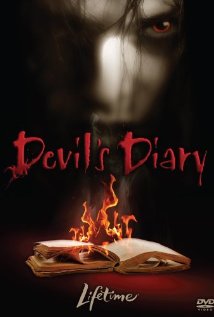
Devil's Diary
This is a made for TV Canadian movie. A teen girl plays a prank on her friend at a cemetery, leading to the discovery of an evil object. Ursula, the moody one, finds a blank diary by a gravestone which she believes is something special, although her friend Dominique pooh poohs that idea.
When kids at school pick on Ursula, she writes revenge tales in the diary, which come true. The head of the mean girls, Heather, instigates her entourage to steal the diary, but she finds it empty. It's because another of the entourage, falling under the power of the diary, has kept the real thing for herself and uses it for her own devices.
Meanwhile, Dominique, concerned about the strange change in Ursula's demeanor, consults her local priest. He and another priest realize the Devil's diary is real and tries to get the diary back. Dominique tries to form an intervention for Ursula but it is too late.
When kids at school pick on Ursula, she writes revenge tales in the diary, which come true. The head of the mean girls, Heather, instigates her entourage to steal the diary, but she finds it empty. It's because another of the entourage, falling under the power of the diary, has kept the real thing for herself and uses it for her own devices.
Meanwhile, Dominique, concerned about the strange change in Ursula's demeanor, consults her local priest. He and another priest realize the Devil's diary is real and tries to get the diary back. Dominique tries to form an intervention for Ursula but it is too late.
Monday, April 8, 2013
Free event: The Exorcist
April continues to be a good month for free screenings. Chicago's Harold Washington Library Center is hosting another film directed by William Friedkin. The Exorcist was the first movie that really scared me, to the point that I couldn't sleep! And this was the tv version which was probably cut down somewhat for broadcast, although I am not sure if back then the tv channels would cut out all the graphic visuals like they would do nowadays for broadcast, non-cable tv. You can't deny that many modern day horror movies owe something if not a lot to The Exorcist and how horror was visually depicted in the movies.The last event in this series takes place on April 16, when Mr. Friedkin speaks and will sign his new book. Mark your calendars!
The Exorcist
Tuesday, April 9, 2013
6:00 p.m.
Harold Washington Library Center
Cindy Pritzker Auditorium
400 S. State Street
Thursday, April 4, 2013
Berberian Sound Studio
I thought this was an entirely Italian film but it is U.K.-made and stars Toby Jones. The synopsis of the movie made it sound very similar to Blow Out, the movie that starred John Travolta as a movie sound effects guy who discovers something sinister. For some reason I thought Berberian was a remake of that movie (although it is not).
It is a period film taking place in the 60s or 70s, when there was a popular Italian film genre called "giallo," where horror is mixed with sex and demonic themes. (Although giallo movies are B-movies many of them are cult classics now here in the U.S.) The film that the people in the movie are working on, seemingly about a girl's school which sits on an ancient witch's coven, has already been made, and the actors are redubbing their voices and sound effects and music are being put in. Gilderoy (Jones) a famed English sound mixer, has been hired to mix the sound elements of this movie.
The film is at first about Gilderoy not "getting" the Italian way of doing things, and then his sanity being tested. It juxtaposes his uptight English manner with the loose and more immoral ways of the Italians. The actresses are treated as sex objects by the male director and producers. The director brings his dog to the studio, ruining recording sessions. Most of the other staff would rather party. The sound director wants things done his way--loud and crude--rather than making an effort for a more artistic product like Gilderoy and one of the actresses want. Very few of them seem to take this seriously and are just intent on cranking it out.
A lot in the film is suggested and brought up but not explained for the audience and the film ends with a lot of unanswered questions. For instance, the film Gilderoy is working on, Equestrian Vortex, is never seen by us the audience except for a garish title sequence. We are told what is happening in Vortex as one of the characters of Berberian describes the upcoming scene for the sound artists so they can get in the mood to do their work, so we can tell if a demon is in the scene or if one of the schoolgirls are being ravished. Gilderoy also makes his own sound effects, like using a blender to mimic a chainsaw, which plants the seed in our heads that things are not always what they appear to be. Dialogue in Berberian allude to the fact that Gilderoy seems to be pretty well-regarded in the industry, yet he is working on this B-movie--why? The film also plants some ideas about some dark secret in Gilderoy's past which forced him to escape to Italy. Was he involved in a crime? His mother writes him cheery letters about finding a bird's nest and later about these birds being killed. I started to wonder if these were old letters and Gilderoy had been living in Italy for a long time and perhaps the mother was dead, even killed (the letters are not dated).
Gilderoy also begins having lucid nightmares or hallucinations, then about two thirds into the film, Gilderoy seems to be in the movie itself. He is dubbed in Italian, watching himself on screen reacting to the same events he is living. Is he a real person, or is he a character in the movie? Is he mad?
It is a period film taking place in the 60s or 70s, when there was a popular Italian film genre called "giallo," where horror is mixed with sex and demonic themes. (Although giallo movies are B-movies many of them are cult classics now here in the U.S.) The film that the people in the movie are working on, seemingly about a girl's school which sits on an ancient witch's coven, has already been made, and the actors are redubbing their voices and sound effects and music are being put in. Gilderoy (Jones) a famed English sound mixer, has been hired to mix the sound elements of this movie.
The film is at first about Gilderoy not "getting" the Italian way of doing things, and then his sanity being tested. It juxtaposes his uptight English manner with the loose and more immoral ways of the Italians. The actresses are treated as sex objects by the male director and producers. The director brings his dog to the studio, ruining recording sessions. Most of the other staff would rather party. The sound director wants things done his way--loud and crude--rather than making an effort for a more artistic product like Gilderoy and one of the actresses want. Very few of them seem to take this seriously and are just intent on cranking it out.
A lot in the film is suggested and brought up but not explained for the audience and the film ends with a lot of unanswered questions. For instance, the film Gilderoy is working on, Equestrian Vortex, is never seen by us the audience except for a garish title sequence. We are told what is happening in Vortex as one of the characters of Berberian describes the upcoming scene for the sound artists so they can get in the mood to do their work, so we can tell if a demon is in the scene or if one of the schoolgirls are being ravished. Gilderoy also makes his own sound effects, like using a blender to mimic a chainsaw, which plants the seed in our heads that things are not always what they appear to be. Dialogue in Berberian allude to the fact that Gilderoy seems to be pretty well-regarded in the industry, yet he is working on this B-movie--why? The film also plants some ideas about some dark secret in Gilderoy's past which forced him to escape to Italy. Was he involved in a crime? His mother writes him cheery letters about finding a bird's nest and later about these birds being killed. I started to wonder if these were old letters and Gilderoy had been living in Italy for a long time and perhaps the mother was dead, even killed (the letters are not dated).
Gilderoy also begins having lucid nightmares or hallucinations, then about two thirds into the film, Gilderoy seems to be in the movie itself. He is dubbed in Italian, watching himself on screen reacting to the same events he is living. Is he a real person, or is he a character in the movie? Is he mad?
Tuesday, October 16, 2012
CIFF 2012: Sleep Tight
Although at first we are led by his actions and narrating dialogue to believe he is a typical stalker, this is not exactly (or not initially) about sex. Cesar is depressed, to the point where he cannot stand that Clara always has a smile on her face. His vendetta against her to is to make her as unhappy as he is.
Cesar's actions against Clara get more and more extreme. He injects chemicals into her lotions to cause a rash. He infests her apartment with bugs. In one scene he is almost caught by Clara's boyfriend. Later we come to know that Cesar has sexually violated Clara without her knowledge.
We see that the neighbor kid across the hall has seen some of this illicit behavior and has been blackmailing Cesar. A curmudgeon tenant has looked into Cesar's past and discovered he has never been able to keep a job, suggesting to us that Cesar has done this many times before. Cesar frames the cleaning lady's son when the police discover the stalker letters. All this causes Cesar to contemplate suicide.
CIFF 2012: The Citadel
In an unnamed desolate Irish neighborhood, a young couple are preparing to leave their condemned public housing high rise. They are looking for a more hopeful future as she is pregnant. As Tommy gets in the elevator to go down, his wife is attacked by some creepy faceless kids in hooded sweatshirts, who seem to want her unborn child. She dies but the baby is saved.
As a result, Tommy has become paranoid and fearful of leaving his new but equally bad public housing apartment. He barricades himself and his baby inside and can barely force himself out to attend therapy sessions to confront his fear and agoraphobia. At his wife's funeral, he meets an angry priest who seems to know something of the creatures who killed his wife. A caring nurse tries to help Tommy.
Later the priest reveals that the creatures are people who have been infected by the evil of the high rise, turning into zombie-ish creatures who prey on those on whom they smell fear. With the help of a blind boy, who appears to be one of those creatures but has been helping the priest, they are shielded from the blind creatures' smell and are able to escape.
Wednesday, June 20, 2012
The Company of Wolves
A version of the Little Red Riding Hood story, based on some short stories. Directed by Neil Jordan who co-wrote with the original author Angela Carter.
It begins in modern day where Rosaleen (Sarah Patterson, about 12 or 13 at the time although she looks more mature here), is having a nightmare. In her dream, which is the majority of the film, the characters are also played by the actors playing her real life family.
A girl, who is her sister, is running through a surreal forest where she is chased and killed by wolves. Later in the dream, Rosaleen is sent to live with her granny (Angela Lansbury) for a while for her safety, and granny is often admonishing her to not “stray off the path,” both physically and metaphorically. While Granny knits a red shawl for Rosaleen, she tells several horror stories involving werewolves to demonstrate her warnings.
All of the stories depicted have sexual overtones.
It begins in modern day where Rosaleen (Sarah Patterson, about 12 or 13 at the time although she looks more mature here), is having a nightmare. In her dream, which is the majority of the film, the characters are also played by the actors playing her real life family.
A girl, who is her sister, is running through a surreal forest where she is chased and killed by wolves. Later in the dream, Rosaleen is sent to live with her granny (Angela Lansbury) for a while for her safety, and granny is often admonishing her to not “stray off the path,” both physically and metaphorically. While Granny knits a red shawl for Rosaleen, she tells several horror stories involving werewolves to demonstrate her warnings.
All of the stories depicted have sexual overtones.
Monday, April 2, 2012
Bluebeard (2009)
This French film is directed by Catherine Breillat, a filmmaker known for using sexual themes involving (usually) young women/girls.
Two sets of sisters relate the story of Bluebeard, the murderous wife killer of the old fairy tale. In the sisters of 1950s France, the younger of the two, Catherine, seems to know how to push her older sister Marie-Anne's buttons as they explore an attic in a country cottage. Catherine daringly taunts her about the story of Bluebeard, which scares Marie-Anne. The film goes back and forth between these girls and the girls of the fairy tale they are reading, which takes place in medieval times.
In the medieval story, teen sisters Anne and Marie-Catherine have just lost their father and since they are female, the well-being of their futures are dependent on marriage. As in the 1950s story, it is the younger sister, Marie-Catherine (Lola Creton), who is the central figure. She sees Bluebeard's castle in the distance and is captivated by the stories of him and the many wives who have disappeared without a trace. This doesn't scare her. In fact, when Bluebeard (Dominique Thomas) offers marriage to her or her sister despite knowing they have no dowries, Marie-Catherine is pleased to take the chance.
Two sets of sisters relate the story of Bluebeard, the murderous wife killer of the old fairy tale. In the sisters of 1950s France, the younger of the two, Catherine, seems to know how to push her older sister Marie-Anne's buttons as they explore an attic in a country cottage. Catherine daringly taunts her about the story of Bluebeard, which scares Marie-Anne. The film goes back and forth between these girls and the girls of the fairy tale they are reading, which takes place in medieval times.
In the medieval story, teen sisters Anne and Marie-Catherine have just lost their father and since they are female, the well-being of their futures are dependent on marriage. As in the 1950s story, it is the younger sister, Marie-Catherine (Lola Creton), who is the central figure. She sees Bluebeard's castle in the distance and is captivated by the stories of him and the many wives who have disappeared without a trace. This doesn't scare her. In fact, when Bluebeard (Dominique Thomas) offers marriage to her or her sister despite knowing they have no dowries, Marie-Catherine is pleased to take the chance.
Monday, February 6, 2012
The Woman in Black
Harry Potter's Daniel Radcliffe stars in this period horror film. He plays a young widower and father, working in an attorney’s office. While his employer sympathizes with his grief of his wife’s death in childbirth(several years now since his son is four years old), he gives Arthur one last chance to buckle down. Arthur is to go through the papers of a client who has died, to make sure there is not another will in existence. When Arthur gets to the client's town, the innkeeper claims he has no room for him and puts him up in the attic, where we see in a prologue his three daughters jumped out the window and killed themselves. Several other children have killed themselves or died in similar creepy and mysterious accidents, which Arthur finds out in time. He is befriended by a wealthy couple (Ciaran Hinds, Janet McTeer) who have also lost a child, whom the wife claims possesses her and speaks through her.
Monday, October 31, 2011
Halloween horror: Vincentennial: A Halloween Tribute to Vincent Price Part 2
The Vincentennial event at the Portage Theatre was pretty fun. This was the first time I attended this elegant theatre, despite it being just a short bus ride from me.
The highlight of the evening was when Vincent's daughter, Victoria Price, gave a talk on her father while accompanied by a fan-created slide show of studio photos, home photos, and video clips of Victoria's much older brother adding some remembrances. She's been going around the country celebrating this once in a lifetime centennial. I'm sure you have heard what a very appreciative and nice person Vincent Price was, this was confirmed by his daughter, who said he always took time out to greet fans and acknowledge their major role in his career. She also told stories of how funny, sincere, hard-working and loving he was, as well as his diverse interests in later life with art collection, travel and as a gourmand.
Two films were also screened, the first was House on Haunted Hill. Price plays a rich man who buys the attendance of several strangers to join him and his wife, played by Carole Ohmart, in an overnight stay in a supposed haunted house. The typist who is invited keeps coming up against what she believes are ghosts, despite no one else witnessing these encounters. When the rich man's wife dies, it creates a tension that the group must suffer the rest of the night.
The second film was The Last Man on Earth. It is an apocalyptic film where Price plays a researcher hoping to find the cure for a plauge that has decimated the world. We see how his family has succumbed to the plague, and he now lives alone, tormented by zombielike vampires who threaten to burst in every night. This looked as if it was filmed in Italy and dubbed in English, and pretty low budget.
I saw a few people in attendance in Halloween garb but I don't think anyone specifically dressed as to a Vincent Price character or film. Several vendors were there with posters, buttons, photos and other memorabilia for sale. Victoria also did a meet and greet and signed autographs too.
Other little highlights were the additional screenings of two shorts that Vincent Price had a key role in. The first was the early TIm Burton short film Vincent, where a boy named Vincent Malloy wishes he were Vincent Price. In this film, you can already see Burton's signature gothic style of puppetry which featured in his stop-motion films the Nightmare Before Christmas and Corpse Bride. Of course, Burton also had many animated stop-motion elements in other films such as Beetlejuice, Pee-Wee's Big Adventure, and Mars Attacks! And certainly his gothic sensibilities has truly infused his career.
The other little highlight was the music video for Michael Jackson's song Thriller. This was directed and co-written by John Landis, a true "creature feature" director/fan who seemed to be the perfect partner to Jackson to create this short story out of a song. Price narrates a rhymed dialog in part of the video (it's listed as a "rap"). Seeing it on the big screen, I didn't realize how little of this was singing, and how much of it is a real narrative of a horror film.
The highlight of the evening was when Vincent's daughter, Victoria Price, gave a talk on her father while accompanied by a fan-created slide show of studio photos, home photos, and video clips of Victoria's much older brother adding some remembrances. She's been going around the country celebrating this once in a lifetime centennial. I'm sure you have heard what a very appreciative and nice person Vincent Price was, this was confirmed by his daughter, who said he always took time out to greet fans and acknowledge their major role in his career. She also told stories of how funny, sincere, hard-working and loving he was, as well as his diverse interests in later life with art collection, travel and as a gourmand.
Two films were also screened, the first was House on Haunted Hill. Price plays a rich man who buys the attendance of several strangers to join him and his wife, played by Carole Ohmart, in an overnight stay in a supposed haunted house. The typist who is invited keeps coming up against what she believes are ghosts, despite no one else witnessing these encounters. When the rich man's wife dies, it creates a tension that the group must suffer the rest of the night.
The second film was The Last Man on Earth. It is an apocalyptic film where Price plays a researcher hoping to find the cure for a plauge that has decimated the world. We see how his family has succumbed to the plague, and he now lives alone, tormented by zombielike vampires who threaten to burst in every night. This looked as if it was filmed in Italy and dubbed in English, and pretty low budget.
I saw a few people in attendance in Halloween garb but I don't think anyone specifically dressed as to a Vincent Price character or film. Several vendors were there with posters, buttons, photos and other memorabilia for sale. Victoria also did a meet and greet and signed autographs too.
Other little highlights were the additional screenings of two shorts that Vincent Price had a key role in. The first was the early TIm Burton short film Vincent, where a boy named Vincent Malloy wishes he were Vincent Price. In this film, you can already see Burton's signature gothic style of puppetry which featured in his stop-motion films the Nightmare Before Christmas and Corpse Bride. Of course, Burton also had many animated stop-motion elements in other films such as Beetlejuice, Pee-Wee's Big Adventure, and Mars Attacks! And certainly his gothic sensibilities has truly infused his career.
The other little highlight was the music video for Michael Jackson's song Thriller. This was directed and co-written by John Landis, a true "creature feature" director/fan who seemed to be the perfect partner to Jackson to create this short story out of a song. Price narrates a rhymed dialog in part of the video (it's listed as a "rap"). Seeing it on the big screen, I didn't realize how little of this was singing, and how much of it is a real narrative of a horror film.
Witchfinder General (The Conqueror Worm)
This is a late 1960s horror-ish British film about a man (Vincent Price) who supposedly sniffs out witches in the time of Cromwell. Typical of persecution stories, the witchfinder has abused his power and convinced others that he has the ability to determine who is a witch or not. Also common in films of this sort is the beautiful maid and her loyal beau, in this case he one of Cromwell's soldiers.
Saturday, October 29, 2011
CIFF 2011: Kaidan Horror Classics
Japan horror is way out there. I think out of all the styles of Asian horror, Japan has tapped into making terrifying something that is based on realism, yet still making it way out of one's imagination so that we just want to hide from the potental terror it suggests. This program consisted of four teleplays, based on classic Japanese horror literature. These films had more of a dark, moody element rather than the shocking twists that we are used to.
The Arm tells the story of a man with a fetish for a woman's arm. He is obsessed with its shape and beauty. One night she comes to him and agrees to let him have it for the night, and detaches it. He spends time in his lonely room caressing the arm and speaking to it, until he is so enamored that he detaches is own arm and replaces it with the woman's arm. I think it was a mistake to start the program with this story, as its creepy premise seemed to turn some people off and several viewers walked out. The other stories are more accessible so it would probably make sense to move this one further down in the program rather than having it as the introductory piece.
The Whistler. A young woman lies dying, while her sister, who cares for her, finds secret love letters. Both these women have longed for love but due to their situation, neither have had the love they hoped for. The sickly sister finally admits the truth about the letters, the well sister has seen her soldier lover off to war, a relationship her father disapproves of. This is more a story about unrequited love than real horror. Like the others though, it is heavy on mood.
The Nose tells the story of a hermit monk. Due to a hideous nose, he hides his face from the townsfolk. After an unsuccessful attempt to rescue a drowning boy, the monk feels guilty, which is further explained later in the story. While the town at first saw him as a pitiful monk, once they see his nose their superstition and hatred come forth. Although the monk is the "cause" of the drowning, it is hard not to sympathize with his treatment by the town and to understand his guilt.
The fourth story, The Days After, has a more straightforward plot. A couple receives visits from a boy they imagine and hope is the personification of their deceased son. They spend quality time with the boy, knowing he may leave at any moment. Their anguish is apparent, but after a time they realize they must let him go. This type of plot has been tried in other movies before. It just has a more Japanese sensibility here.
All the stories are slow moving, with an arthouse, low-budget feel to the stage direction and scenes. There is a minimum of dialogue, some choosing to supplement with first person narration or thoughts of the protagonist. I don't think this will turn anyone on to trying a Japanese horror film, but it may interest someone in picking up some Japanese horror stories instead.
The Arm tells the story of a man with a fetish for a woman's arm. He is obsessed with its shape and beauty. One night she comes to him and agrees to let him have it for the night, and detaches it. He spends time in his lonely room caressing the arm and speaking to it, until he is so enamored that he detaches is own arm and replaces it with the woman's arm. I think it was a mistake to start the program with this story, as its creepy premise seemed to turn some people off and several viewers walked out. The other stories are more accessible so it would probably make sense to move this one further down in the program rather than having it as the introductory piece.
The Whistler. A young woman lies dying, while her sister, who cares for her, finds secret love letters. Both these women have longed for love but due to their situation, neither have had the love they hoped for. The sickly sister finally admits the truth about the letters, the well sister has seen her soldier lover off to war, a relationship her father disapproves of. This is more a story about unrequited love than real horror. Like the others though, it is heavy on mood.
The Nose tells the story of a hermit monk. Due to a hideous nose, he hides his face from the townsfolk. After an unsuccessful attempt to rescue a drowning boy, the monk feels guilty, which is further explained later in the story. While the town at first saw him as a pitiful monk, once they see his nose their superstition and hatred come forth. Although the monk is the "cause" of the drowning, it is hard not to sympathize with his treatment by the town and to understand his guilt.
The fourth story, The Days After, has a more straightforward plot. A couple receives visits from a boy they imagine and hope is the personification of their deceased son. They spend quality time with the boy, knowing he may leave at any moment. Their anguish is apparent, but after a time they realize they must let him go. This type of plot has been tried in other movies before. It just has a more Japanese sensibility here.
All the stories are slow moving, with an arthouse, low-budget feel to the stage direction and scenes. There is a minimum of dialogue, some choosing to supplement with first person narration or thoughts of the protagonist. I don't think this will turn anyone on to trying a Japanese horror film, but it may interest someone in picking up some Japanese horror stories instead.
Friday, October 28, 2011
Halloween horror: Ed Gein
Here's one to get you in the "holiday mood": Ed Gein aka In the Light of the Moon.Ed Gein is a real life serial killer. He was supposedly the model for Norman Bates in Psycho, Leather Face of Texas Chainsaw Massacre, and Buffalo Bill of Silence of the Lambs. He is played here by Steve Railsback, who also played Charles Manson in Helter Skelter. He was found out in the 50s, when most of this film takes place.
Thursday, October 27, 2011
Halloween horror: Vincentennial: A Halloween Tribute to Vincent Price
Just spreading the word about an event, not free, but rather cool! Really, how often can you celebrate one of moviedoms iconic actors, Vincent Price, with a centennial tribute? And on Halloween weekend too!
Chicago's Portage Theatre, known for many screenings of silent, vintage, rare and beloved cult films, has a special program October 30, Vincentennial: A Halloween Tribute To Vincent Price. Special guest is Vincent's daughter Victoria, who will be available for fan adoration. She will present The House on Haunted Hill and The Last Man on Earth. Intermission between the films will be a Q&A session with Ms. Price. There is also a costume contest and memorabilia and other things for sale.
Vincentennial: A Halloween Tribute to Vincent Price
October 30
doors open at 1:00 p.m. (event ends about 7:00 p.m.)
Portage Theater
4050 N. Milwaukee Avenue
$15 at door for a double feature
Chicago's Portage Theatre, known for many screenings of silent, vintage, rare and beloved cult films, has a special program October 30, Vincentennial: A Halloween Tribute To Vincent Price. Special guest is Vincent's daughter Victoria, who will be available for fan adoration. She will present The House on Haunted Hill and The Last Man on Earth. Intermission between the films will be a Q&A session with Ms. Price. There is also a costume contest and memorabilia and other things for sale.
Vincentennial: A Halloween Tribute to Vincent Price
October 30
doors open at 1:00 p.m. (event ends about 7:00 p.m.)
Portage Theater
4050 N. Milwaukee Avenue
$15 at door for a double feature
Subscribe to:
Posts (Atom)